How to Price Your DIY Crafts for Etsy: A Beginner’s Guide

- How to Price Your DIY Crafts for Etsy: A Beginner’s Guide
- 📋 Key Takeaways
- Table of Contents
- 1. Understanding the True Cost of Your Crafts
- Tracking Your Material Costs Down to the Penny
- Paying Yourself for Labor
- Don't Forget the Hidden Overhead
- 2. The Golden Pricing Formula Every Seller Needs
- Why Multiply by Two?
- A Real-World Calculation
- 3. Factoring in Etsy Fees Without Losing Your Mind
- The Core Fees
- The Wildcard: Offsite Ads
- How to Protect Your Profit
- 4. How to Price Crafts for Etsy: Psychological Strategies
- The "Free Shipping" Illusion
- Charm Pricing (The Power of 9)
- Premium Pricing for Perceived Value
- 5. The Power of Tiered Pricing and Bundles
- The "Good, Better, Best" Method
- Creating Bundles
- 6. Evaluating the Market (Without Undercutting Yourself)
- Why Are They Cheaper?
- Elevating Above the Competition
- 7. When and How to Raise Your Prices
- Signs It's Time to Raise Your Prices
- How to Communicate Price Increases
- Wrapping Up: Your Next Steps
- Frequently Asked Questions (FAQ)
- What is a good profit margin for Etsy crafts?
- Should I offer free shipping on Etsy?
- How do I price digital products on Etsy?
- Do I have to charge sales tax on Etsy?
- What happens if my formula price is way higher than my competitors?
how to price crafts for etsy: 7 Critical Steps to Maximize Your Profits in 2026
Picture this: You just spent three hours meticulously crafting a beautiful, custom-designed piece of home decor. You take stunning photos, write the perfect description, and list it online. Within minutes, a customer buys it, and you do a little happy dance in your workspace. But then reality hits. When you check your bank account after deducting the cost of materials, shipping labels, and platform fees, you realize you made exactly $1.50 for three hours of hard work. Ouch. If you want to build a sustainable and thriving business, figuring out how to price crafts for etsy is the single most important skill you need to master.
Pricing isn’t just about guessing a number that “feels right” or blindly copying what the shop next door is doing. It is a strategic balance of hard math, buyer psychology, and market awareness. Get it wrong, and you will either scare away potential buyers with exorbitant tags or work yourself into absolute burnout for pennies. Let’s fix that right now. In this comprehensive guide, I will walk you through the exact formulas, fee structures, and psychological triggers you need to turn your creative hobby into a highly profitable enterprise.
📋 Key Takeaways
- Understanding how to price crafts for etsy requires meticulously calculating materials, hourly labor, and hidden overhead costs.
- The industry-standard pricing formula is: (Materials + Labor + Expenses) x 2 = Wholesale Price. Wholesale Price x 2 = Retail Price.
- Etsy takes a significant cut through listing fees ($0.20), transaction fees (6.5%), and payment processing (3% + $0.25). You must bake these into your base price.
- Psychological pricing strategies, such as incorporating shipping costs to offer “Free Shipping,” can dramatically increase conversion rates.
- Offering tiered product options helps capture both budget-conscious shoppers and premium buyers without cheapening your brand.
1. Understanding the True Cost of Your Crafts
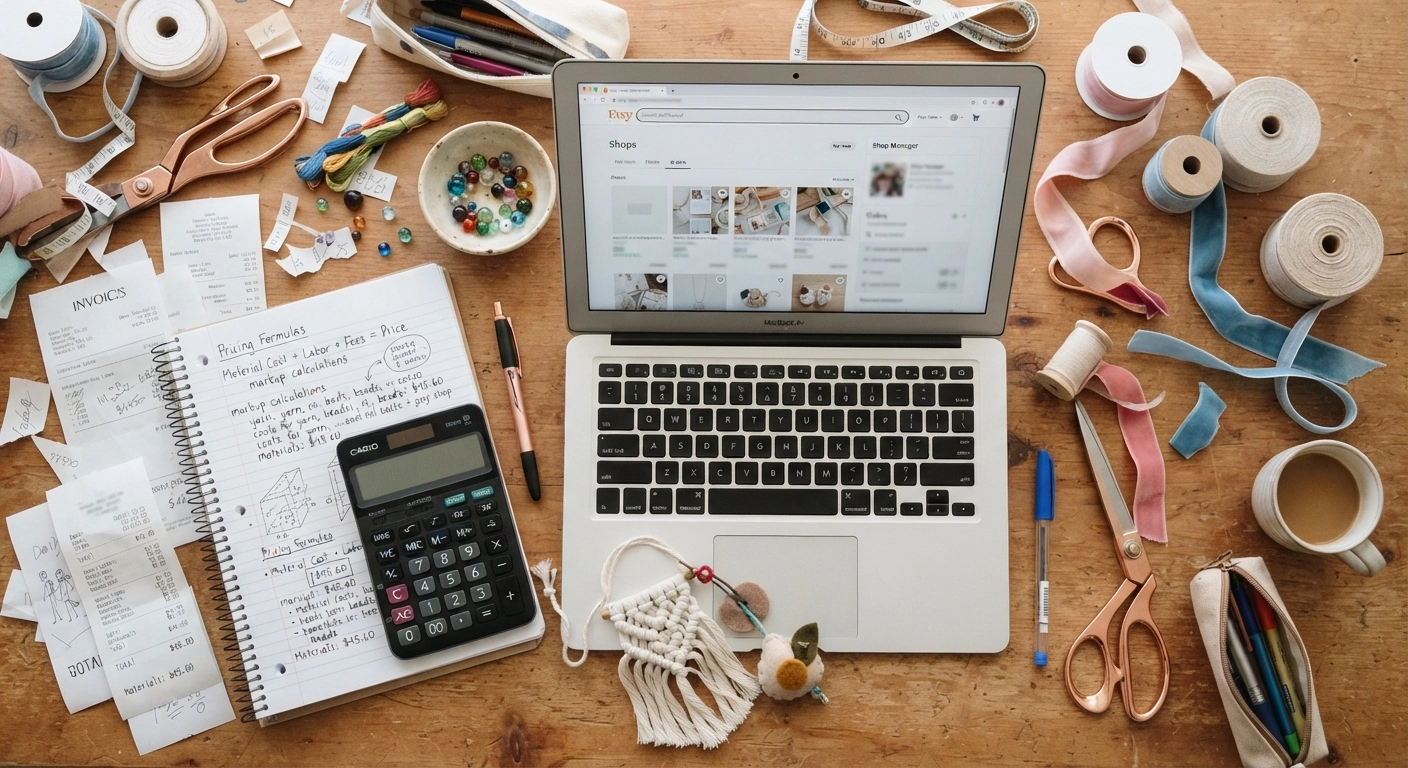
Before you can even think about profit margins or marketing, you have to know exactly how much money goes into creating a single item. Most beginners only count the big, obvious materials. They forget the glue, the packaging, and most importantly—their own time.
If you are learning how to price crafts for etsy, you need to break your costs down into three distinct categories: Materials, Labor, and Overhead.
Tracking Your Material Costs Down to the Penny
Let’s say you are making a product from our how to make easy scented candles guide. You know the wax and the fragrance oil cost money. But what about the warning label on the bottom of the jar? What about the bubble wrap you use to ship it safely? What about the thank-you card you slip into the box?
Every single component must be calculated. The easiest way to do this is to take the bulk price of an item and divide it by the yield.
- Example: You buy 10 lbs of soy wax for $30. Each candle uses 0.5 lbs. Your wax cost per candle is $1.50.
- Example: You buy a roll of 500 shipping labels for $15. Your label cost per order is $0.03.
Paying Yourself for Labor
This is where 90% of creative entrepreneurs fail. You are not a machine, and your time is valuable. If you don’t factor in an hourly wage, you are essentially working for free. Decide on an hourly rate that reflects your skill level. If minimum wage in your area is $15/hour, and it takes you 30 minutes to make an item, your labor cost is $7.50.
Do not shortchange yourself here. As your skills improve, your hourly rate should increase, even if you get faster at making the product.
Don’t Forget the Hidden Overhead
Overhead includes all the things you need to run your business that aren’t directly tied to a single physical product. This includes:
- Electricity for your tools
- Internet bills
- Software subscriptions (like Canva or accounting tools)
- Equipment depreciation (wear and tear on your machines)
If you are trying to decide between investing in new equipment, you might want to read our breakdown on glowforge vs cricut to understand how machine costs impact your long-term overhead. To calculate overhead per item, take your monthly overhead expenses and divide them by the number of items you realistically produce in a month.
2. The Golden Pricing Formula Every Seller Needs
Now that we have all our raw numbers, what do we do with them? The biggest mistake you can make is just adding a random $5 to your costs and calling it a day.
When mastering how to price crafts for etsy, you need a formula that protects you against unexpected expenses, allows room for sales and discounts, and leaves the door open for future wholesale opportunities.
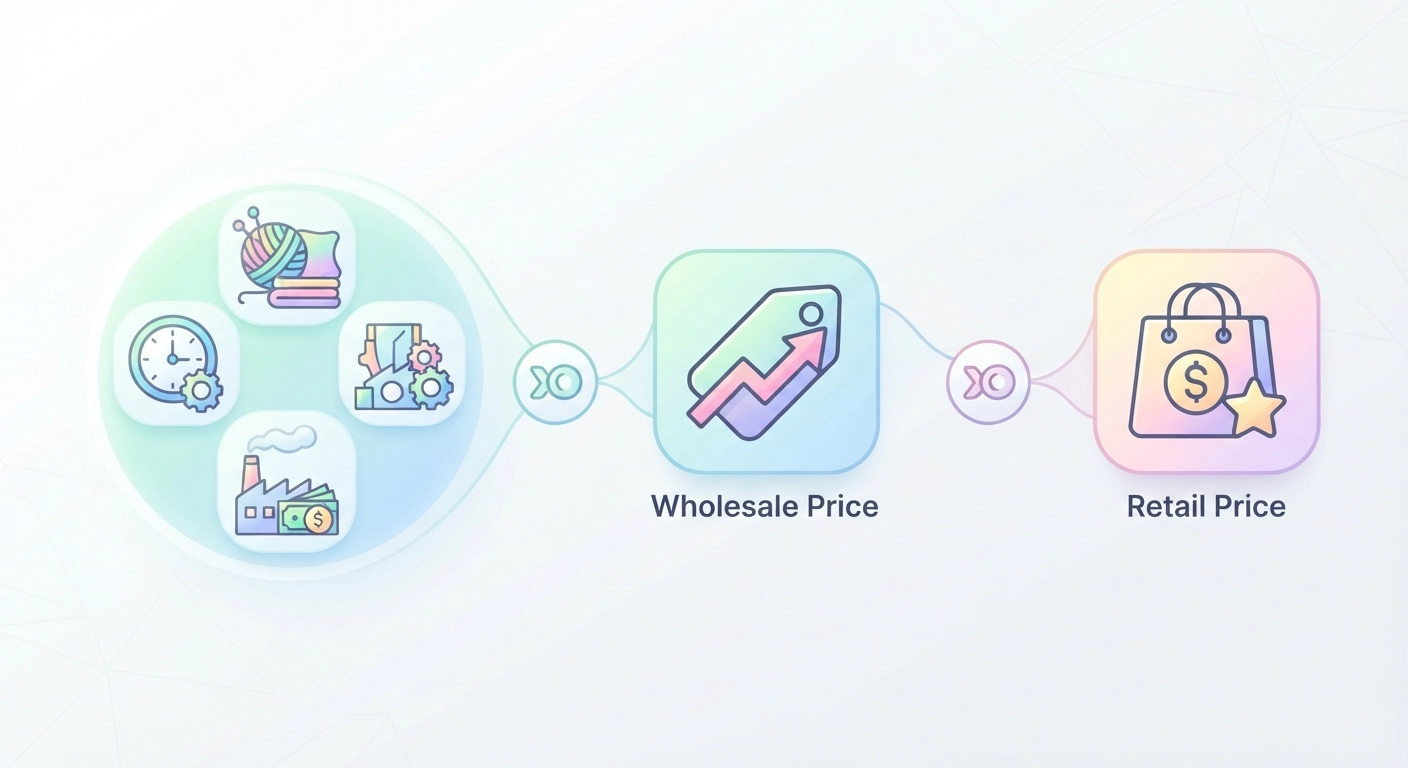
Here is the industry-standard golden formula:
Step 1: Materials + Labor + Overhead = Cost of Goods Sold (COGS)
Step 2: COGS x 2 = Wholesale Price
Step 3: Wholesale Price x 2 = Retail Price (Your Etsy Price)
Let’s break down why this specific multiplier exists.
Why Multiply by Two?
You might look at that formula and think, “Multiplying by four from my base cost? That’s way too expensive! Nobody will buy it.”
Here is the reality: If you ever want to sell your products in local boutiques or to other retailers, they will expect to buy from you at wholesale prices (which is typically 50% of the retail price). If your retail price on Etsy is only slightly above your COGS, you will actually lose money trying to sell wholesale.
Furthermore, having that built-in margin allows you to run 20% off sales during Black Friday or offer free shipping without eating into your actual survival money.
A Real-World Calculation
Let’s put this into practice with a hypothetical handmade leather wallet.
- Materials: Leather, thread, dye, packaging = $8.00
- Labor: 1 hour at $20/hour = $20.00
- Overhead: $2.00 per item
- COGS: $30.00
Wholesale Price: $30.00 x 2 = $60.00
Retail Price: $60.00 x 2 = $120.00
If $120 feels terrifyingly high to you, the solution isn’t to slash your price to $45. The solution is to either speed up your production time (reducing labor costs), source cheaper materials in bulk, or elevate your brand’s perceived value so customers happily pay $120.
3. Factoring in Etsy Fees Without Losing Your Mind
You cannot successfully figure out how to price crafts for etsy without understanding the platform’s cut. Etsy provides incredible traffic and a built-in audience of millions of buyers, but that convenience comes at a cost.
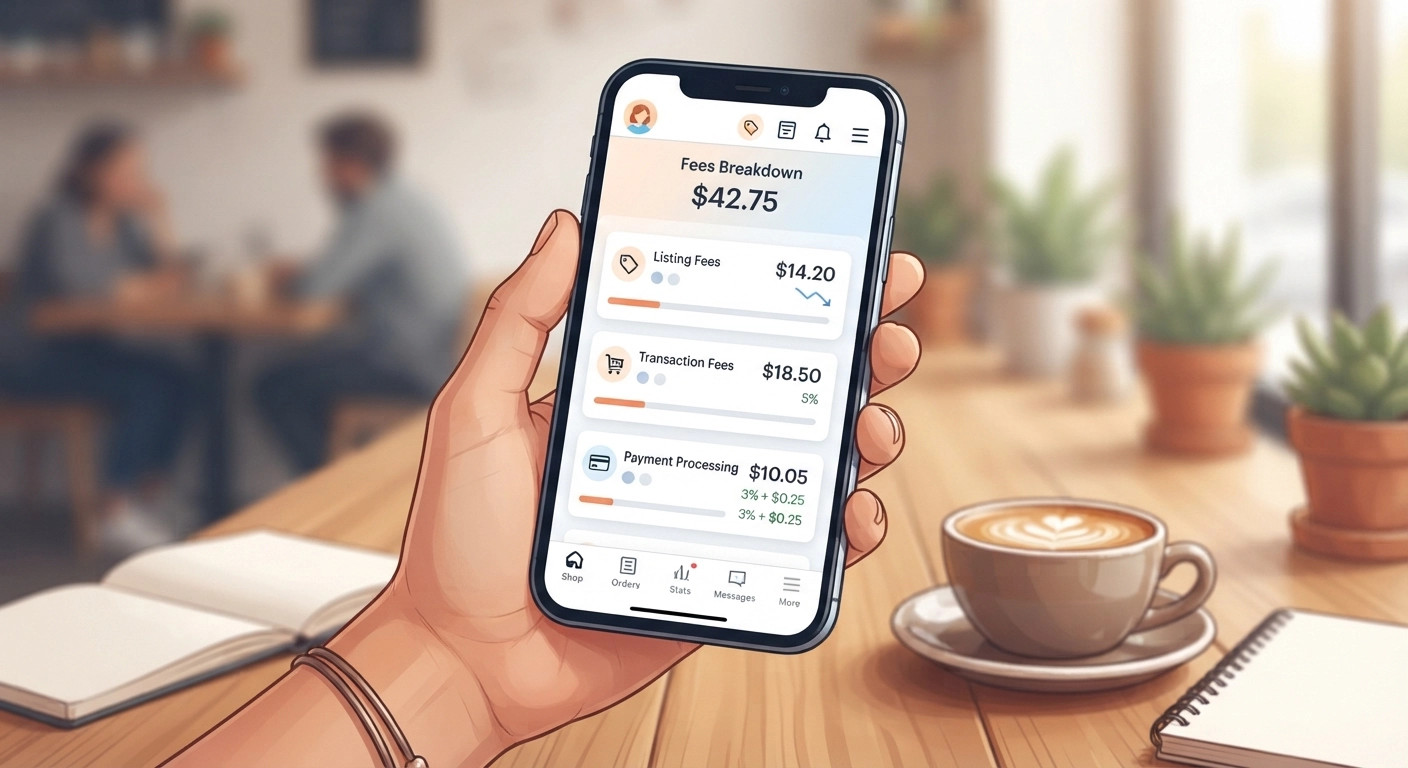
As of 2026, here is the exact breakdown of the fees you need to account for according to the official Etsy fee structure:
The Core Fees
- Listing Fee: $0.20 per item. This is charged when you publish a listing and every time the item sells and auto-renews.
- Transaction Fee: 6.5% of the total order amount. Notice I said total order amount. This includes the cost of the item, the shipping fee you charge the customer, and any gift wrapping.
- Payment Processing Fee: If you use Etsy Payments (which is mandatory in most countries), they charge a processing fee. In the US, this is 3% + $0.25 per transaction.
The Wildcard: Offsite Ads
Etsy advertises your products across Google, Facebook, Instagram, and Pinterest. If a buyer clicks one of those ads and purchases from your shop within 30 days, Etsy takes an additional cut.
– If your shop makes under $10,000 a year, the fee is 15% (and you can opt out).
– If your shop makes over $10,000 a year, the fee is 12% (and you cannot opt out).
How to Protect Your Profit
To ensure you aren’t caught off guard, you should assume that every sale will cost you roughly 9.5% + $0.45 in basic fees. Many successful sellers add a flat 10-15% buffer to their final retail price specifically to cover platform fees and potential Offsite Ad charges.
4. How to Price Crafts for Etsy: Psychological Strategies
Math is only half the battle. The other half is human psychology. When researching how to price crafts for etsy, you will quickly discover that how a price looks is often just as important as what the price actually is.
According to various studies on psychological pricing, consumers do not process numbers purely logically. They process them emotionally. Here are three psychological strategies you can implement today.
The “Free Shipping” Illusion
Amazon Prime forever changed how consumers shop online. Today’s buyers despise paying for shipping. They will happily pay $35 for a ceramic mug with free shipping, but they will abandon their cart if the mug is $28 with $7 shipping.
The trick here is simple: Take your calculated retail price, add your average shipping cost to it, and offer “Free Shipping” to the customer. Your profit remains exactly the same, but the buyer feels like they are getting a premium perk.
Charm Pricing (The Power of 9)
Why does almost everything in retail end in .99 or .95? Because of the “left-digit effect.” As humans read from left to right, our brains anchor onto the first number we see. A product priced at $19.99 feels significantly cheaper than a product priced at $20.00, even though the difference is a single penny.
When you finalize your Etsy pricing, consider adjusting the numbers slightly to hit these psychological sweet spots.
Premium Pricing for Perceived Value
Sometimes, pricing your items higher actually results in more sales. If someone is shopping for a handmade wedding gift, they want something special. If they see a beautiful hand-carved cutting board priced at $15, they might assume it’s cheap, mass-produced, or low quality. If that exact same board is priced at $85, they perceive it as an artisanal, heirloom-quality piece. Don’t be afraid to own your worth.
5. The Power of Tiered Pricing and Bundles
One of the most effective ways to increase your revenue on Etsy without constantly needing to find new customers is to increase your Average Order Value (AOV). You do this by offering options.
Not every buyer has the same budget. If you only offer one version of your product at $50, you lose the customer who only has $20 to spend, and you leave money on the table from the customer who would have happily spent $100.
The “Good, Better, Best” Method
Give your customers choices within the same listing. Let’s use our How to Make Paper Flowers guide as an inspiration point.
- Good (The Entry Level): A single, beautifully crafted paper rose for $15.
- Better (The Core Offer): A small bouquet of 3 roses wrapped in craft paper for $40.
- Best (The Premium Option): A massive, extravagant bouquet of 12 roses in a custom vase for $150.
By doing this, you capture the budget shopper, push most people toward your core offer, and occasionally land a high-ticket sale from someone looking for a showstopper.
Creating Bundles
Bundling is a fantastic way to move inventory and make buyers feel like they are getting a deal. If you sell digital planners, don’t just sell one planner for $10. Offer a “Mega Productivity Bundle” that includes the planner, a budget tracker, and a meal prep guide for $22. The perceived value is massive, and it costs you nothing extra to deliver digital files.
6. Evaluating the Market (Without Undercutting Yourself)
A common question I hear when teaching how to price crafts for etsy is: “What if my formula says my item should be $60, but everyone else on Etsy is selling it for $25?”
This is a terrifying moment for any new seller. Your immediate instinct will be to slash your prices to $24 to beat the competition. Do not do this. Competing solely on price is a race to the bottom, and nobody wins a race to the bottom except the customer who gets a cheap product while you go out of business.
Why Are They Cheaper?
Before you panic, investigate why your competitors are cheaper.
– Are they using cheaper, lower-quality materials?
– Are they mass-producing items overseas and pretending they are handmade? (Unfortunately, this happens on Etsy).
– Are they simply a hobbyist who doesn’t know how to price their work and is actively losing money on every sale?
You do not want to base your business model on someone else’s bad math.
Elevating Above the Competition
If your price needs to be $60 to be profitable, your job is to make the product look like it’s worth $60. You do this through:
- Stunning Photography: Use natural light, lifestyle staging, and high-resolution images.
- Impeccable Branding: Create a cohesive shop aesthetic, professional logo, and beautifully written product descriptions.
- Exceptional Customer Service: Offer personalization options, fast response times, and beautiful unboxing experiences.
Buyers on Etsy are specifically looking for unique, handcrafted items. They are willing to pay a premium if you give them a premium experience.
7. When and How to Raise Your Prices
Your pricing is not set in stone. As the economy shifts, as material costs rise, and as your skills improve, your prices must adapt. Figuring out how to price crafts for etsy is an ongoing, dynamic process.
Signs It’s Time to Raise Your Prices
- You are constantly sold out: If you cannot keep up with demand and are working 80-hour weeks just to fulfill orders, your prices are too low. Raise them by 10-15%. You might lose a few budget buyers, but you will make the same amount of money doing less work.
- Your suppliers raised their prices: If the cost of your wax, fabric, or shipping goes up, your prices must go up immediately to protect your margin.
- Your skills have leveled up: The items you make today are likely much better quality than the items you made a year ago. Your pricing should reflect that expertise.
How to Communicate Price Increases
Many sellers are terrified of angering repeat customers with price hikes. The truth is, reasonable customers understand inflation. You don’t necessarily need to make a grand announcement. Just adjust the prices on your listings.
If you want to be proactive, you can send an email to your newsletter subscribers saying: “Due to rising material costs, our prices will be increasing on the 1st of next month. As a thank you for your loyalty, here is a 15% off coupon to shop at our current prices before the change happens!” This creates urgency and usually results in a massive spike in sales.
Wrapping Up: Your Next Steps
Learning exactly how to price crafts for etsy can feel overwhelming at first. It requires you to look at your beloved hobby through the cold, calculating lens of a business owner. But once you implement the formulas, account for the fees, and embrace the psychology of pricing, a massive weight will lift off your shoulders.
You will no longer be guessing. You will know with absolute certainty that every time your phone chimes with that beautiful Etsy “Cha-Ching” notification, you are actually making a profit.
Take an hour today to sit down with a calculator, pull up your receipts, and run your top three best-selling items through the golden formula. You might be surprised by what you find.
If you’re ready to expand your shop’s inventory with high-margin items, don’t miss our step-by-step guide on Easy DIY Room Decor Aesthetic: 15 Minimalist Ideas for 2026. Happy crafting, and more importantly, happy profiting!
Frequently Asked Questions (FAQ)
What is a good profit margin for Etsy crafts?
A healthy profit margin for handmade crafts on Etsy is typically between 40% and 60%. This means after all materials, labor, overhead, and Etsy fees are deducted, you keep roughly half of the retail price as pure profit to reinvest in your business or pay yourself a bonus.
Should I offer free shipping on Etsy?
Yes, offering free shipping is highly recommended. Etsy’s search algorithm favors listings that offer free shipping, and buyers are psychologically more likely to complete a purchase. Just ensure you roll the average cost of shipping into your item’s base price so you don’t lose money.
How do I price digital products on Etsy?
Pricing digital products is slightly different because there are no physical material costs or shipping fees. Your formula should focus heavily on the initial labor hours it took to design the product, software subscriptions, and platform fees. Most digital planners and printables range from $5 to $25 depending on complexity.
Do I have to charge sales tax on Etsy?
Etsy automatically calculates, collects, and remits sales tax for physical products shipped to most US states and many international locations (like VAT in Europe). However, you are still responsible for understanding your local tax laws and reporting your overall income to your government.
What happens if my formula price is way higher than my competitors?
If your calculated price is significantly higher, do not immediately lower it. Instead, focus on increasing the perceived value of your item through better photography, premium packaging, and emphasizing the high-quality materials you use. Compete on quality, not on price.