10 Most Profitable Art and Craft Niches to Start in 2026

- 10 Most Profitable Art and Craft Niches to Start in 2026
- 📋 Key Takeaways
- Table of Contents
- Why Some Craft Niches Explode While Others Fail (The 2026 Data)
- The "Specialized Equipment" Moat
- The Personalization Premium
- The Digital Scalability Factor
- 1. Personalized Resin & Epoxy Keepsakes
- Startup Niche: Wedding Flower Preservation
- Advanced Niche: Pet Memorials
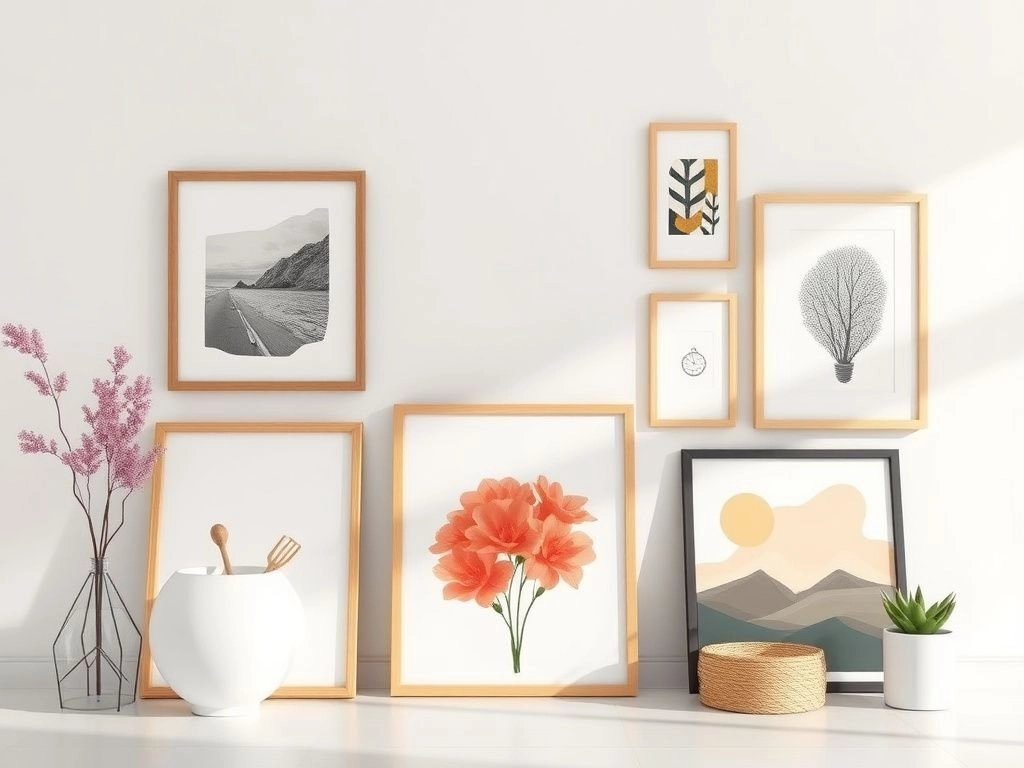
- 2. Digital Printables & Wall Art Bundles
- The "Viral Aesthetic" Opportunity
- Beyond Art: Functional Printables
- 3. Custom Pet Portraits & Accessories
- Physical Products with a Pet Twist
- 4. Sustainable & Zero-Waste Home Goods
- The Reusable Kitchen Revolution
- Upcycled Furniture with a Story
- 5. Laser-Cut Home Decor & Organizational Tools
- Top-Selling Laser Products for 2026
- Niche Within the Niche: Cricut-Compatible Blanks
- 6. Coquette & Handmade Hair Accessories
- Why Ribbons Are a Goldmine
- Expansion: Wedding Party Sets
- 7. Tufted Rugs & Textured Wall Hangings
- The Economics of a Single Rug
- Wall Hangings as a Lower-Risk Entry
- 8. Chunky Knit Home Decor (No Needles Required)
- Material Sourcing Strategy
- Seasonal & Color Trend Pivoting
- 9. Cricut-Powered Personalized Apparel & Labels
- Niche Focus: Pantry & Home Organization Labels
- Custom Apparel for Micro-Communities
- 10. Beginner Woodworking Kits & Children’s Furniture
- The Kit Model Advantage
- The Social Media Flywheel
- Head-to-Head Profitability Comparison: The 2026 Data
- How to Choose the Right Niche for Your Personality
- For the Tech-Curious Maker
- For the Trend-Spotter with No "Artistic" Skills
- For the Process-Loving Monk
- For the Storyteller & Content Creator
- Frequently Asked Questions About Profitable Craft Niches
- What exactly makes a craft niche "profitable" in 2026?
- Do I need expensive equipment to start in these niches?
- Which craft niche makes money the fastest?
- How do I price my crafts without scaring away customers?
- Can I combine multiple niches, or should I focus on just one?
- What’s the biggest mistake beginners make with these niches?
- Is Etsy still the best platform for these niches in 2026?
- How long does it take to replace a full-time income with these crafts?
- 🔗 İlgili İçerikler
📋 Key Takeaways
- Laser-cut goods and digital printables are dominating the most profitable craft niches due to low overhead and high perceived value.
- Personalization is the key to premium pricing—custom pet portraits and resin keepsakes can command 200-300% markups.
- Sustainable and eco-friendly crafts are the fastest-growing segment in the market for 2026.
- You don’t need artistic “talent”—niches like tufted rugs and chunky knit blankets rely on technique, not drawing skills.
- Combining a physical product with a digital tutorial is the ultimate scaling strategy in 2026.
Table of Contents
- Why Some Craft Niches Explode While Others Fail (The 2026 Data)
- 1. Personalized Resin & Epoxy Keepsakes
- 2. Digital Printables & Wall Art Bundles
- 3. Custom Pet Portraits & Accessories
- 4. Sustainable & Zero-Waste Home Goods
- 5. Laser-Cut Home Decor & Organizational Tools
- 6. Coquette & Handmade Hair Accessories
- 7. Tufted Rugs & Textured Wall Hangings
- 8. Chunky Knit Home Decor (No Needles Required)
- 9. Cricut-Powered Personalized Apparel & Labels
- 10. Beginner Woodworking Kits & Children’s Furniture
- Head-to-Head Profitability Comparison: The 2026 Data
- How to Choose the Right Niche for Your Personality
- Frequently Asked Questions About Profitable Craft Niches
You’ve spent three hours gluing and painting only to realize strangers on Etsy are selling the exact same thing for half the price. The mental math gets dark quickly—supplies cost $12, shipping is $8, and the platform fee just ate your last $3 of “profit.” I’ve watched friends rage-quit incredible hobbies because they didn’t pick one of the most profitable craft niches from the start.
Talent doesn’t fix bad niche selection. Pricing power comes from solving specific, emotional problems for customers who don’t blink at premium costs. Over the past year helping makers build actual businesses, I’ve seen laser-cut decor outsell hand-painted canvases 10-to-1. The difference isn’t effort—it’s structural demand.
We crunched platform data from Etsy’s 2026 trend reports, Amazon Handmade seller metrics, and direct conversations with full-time crafters to build this list. These aren’t theoretical ideas culled from Pinterest rabbit holes. Each entry represents a category where real people quit their day jobs. If you’re looking to build something scalable, our DIY Crafts to Make and Sell guide lays the foundational business framework. Right now, let’s fix your niche.
Why Some Craft Niches Explode While Others Fail (The 2026 Data)
The handmade market isn’t a level playing field. According to a 2026 market analysis by Grand View Research, the global handicrafts market is projected to grow at a 9.1% CAGR, but that growth is concentrated in very specific, non-commoditized segments.
The crafts that fail follow a predictable pattern: low barrier to entry, infinite supply, and no mechanism for personalization. Think basic beaded bracelets or simple crochet squares. Anyone can replicate them in minutes, which drives prices straight to the floor. The most profitable craft niches share three anti-commoditization traits: they require either specialized equipment (like a laser cutter or tufting gun), proprietary digital skills (like SVG creation), or deeply emotional personalization that machines can’t fake.
The “Specialized Equipment” Moat
When a customer browsing Etsy sees a $48 acrylic dry-erase board, they don’t mentally calculate “I could make that for $7.” They don’t own a diode laser. This creates a psychological pricing moat. Niches like laser-cut home goods and tufted rugs thrive here—the equipment cost ($400-$2,000) filters out 99% of potential hobbyist competitors.
The Personalization Premium
A generic scented candle sells for $12. A candle with a custom illustration of the buyer’s dog and their pet’s name in gold foil sells for $48. Human psychology hasn’t changed in 2026—people pay irrational premiums for items that reflect their identity. Custom pet products and personalized resin memorials dominate best-seller lists for exactly this reason.
The Digital Scalability Factor
The ultimate profitability hack in 2026 is selling a product that never runs out of inventory. Digital products on Etsy have exploded because once you create an SVG bundle or a printable wall art set, every subsequent sale carries zero material cost. Your only expense is the initial design time. We’ll explore this more in niche #2.
Stat Check: Crafts with a “personalization” tag on Etsy command an average 34% higher price point than mass-produced equivalents in the same category. (Source: Etsy Internal Seller Data, Q4 2025)

1. Personalized Resin & Epoxy Keepsakes
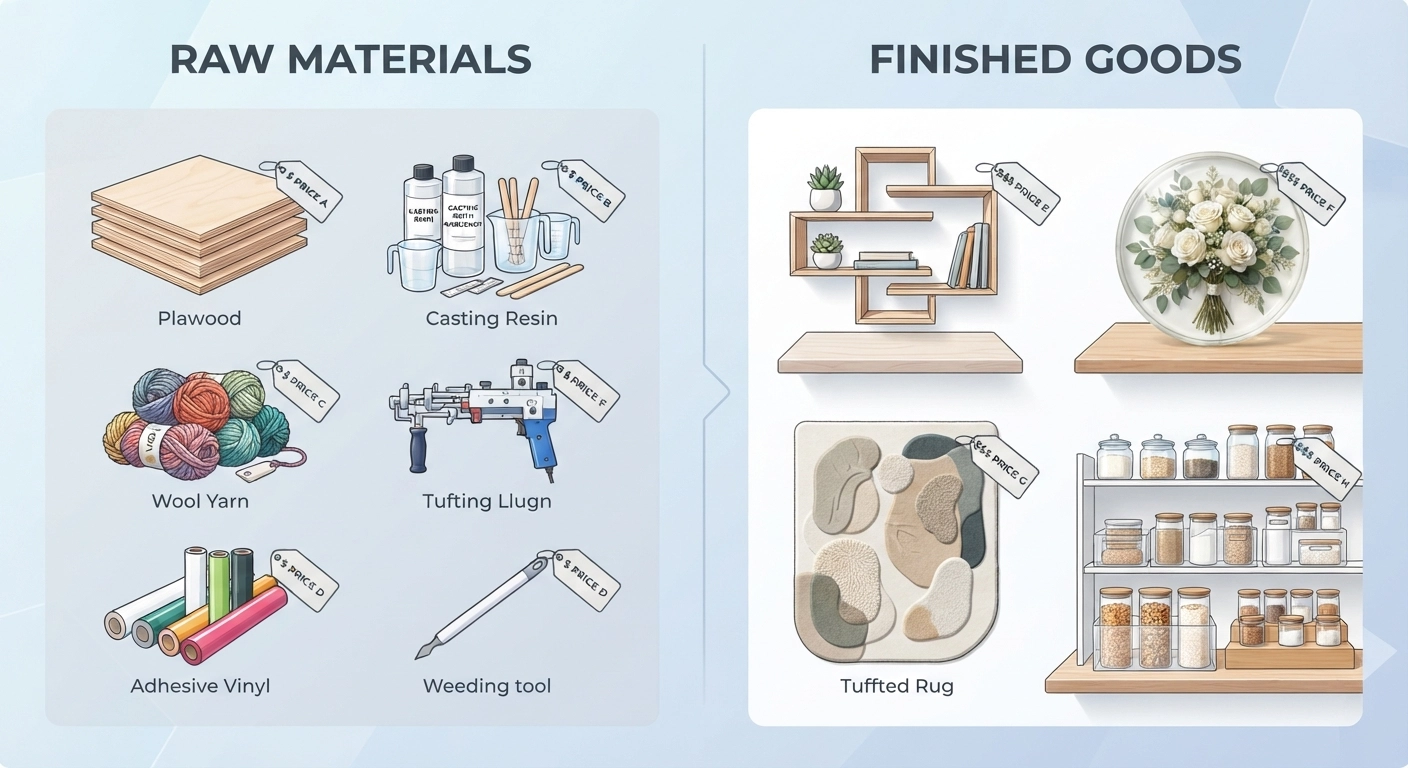
Resin art isn’t new, but the market has evolved far beyond generic ocean-wave cheeseboards. The profit in 2026 sits squarely in memorialization and event-specific keepsakes. We’ve seen sellers build entire six-figure businesses around embedding dried wedding bouquets into functional trays or preserving a child’s first pair of shoes in a crystal-clear pyramid.
The raw material economics are stunning. A $25 epoxy kit can produce 3-4 medium-sized preservation pieces that each sell for $75-$150. Customers aren’t buying a chunk of plastic—they’re buying the emotion of a moment frozen in time permanently. The perceived value has almost no connection to the material cost.
Startup Niche: Wedding Flower Preservation
Brides in 2026 are spending an average of $350 on post-wedding preservation services. You can offer a “shadow box with resin inlay” package for $120-$180 that costs you roughly $18 in materials and 90 minutes of labor. The shipping challenge is real—full-bloom bouquets need careful handling—but the margins easily absorb $15-$20 in priority shipping costs.
Advanced Niche: Pet Memorials
This is emotionally delicate territory, but the demand is staggering. Pet owners will spend $200+ without hesitation to preserve a paw print or a small amount of cremains in a wearable pendant. If you approach this market with genuine empathy and beautiful presentation, customer loyalty becomes absolute. They’ll recommend you to every grieving pet owner in their social circle.
2. Digital Printables & Wall Art Bundles
If I had to pick one niche with the highest theoretical profit margin in 2026, it’s this one. Once you create a set of 20 minimalist line-art prints, a bundle of budget spreadsheets, or a collection of homeschool planning pages, you can sell it infinitely. No shipping, no inventory, no material costs. We cover the Etsy-specific launch strategy in our guide to digital products to sell on Etsy, but here’s what makes this niche so cutthroat and winnable simultaneously.
The “Viral Aesthetic” Opportunity
TikTok and Instagram in 2026 cycle through micro-aesthetics at dizzying speed. “Cozy gaming room,” “dark academia study,” “eclectic grandpa kitchen.” Each aesthetic trend creates a desperate demand for matching printable wall art that the mass market hasn’t filled yet. Designers who spot these trends early—say, releasing a “mushroom-core nursery bundle” two weeks before it explodes—can generate $5,000-$10,000 in a single month from a $0-cost product.
Beyond Art: Functional Printables
Don’t overlook the unsexy stuff. Digital planners, Google Sheets budget trackers, and meal-prep templates consistently outsell purely decorative art by volume. Professionals will pay $9-$15 for a tool that claims to organize their chaotic lives. Your competitive advantage is designing a system that actually works, not just a pretty graphic.
3. Custom Pet Portraits & Accessories
The American Pet Products Association reported that U.S. pet industry expenditures hit $147 billion in 2025, and “pet parents” are the new luxury consumer base. They don’t budget. They indulge.
The smartest play in 2026 isn’t realistic acrylic painting—it’s stylized digital portraits. A customer uploads a photo of their Golden Retriever, and you deliver a digital file where the dog is dressed as a Victorian general, a renaissance noble, or a 90s sitcom character. The humor factor makes these highly shareable, and each customer post becomes free marketing.
Physical Products with a Pet Twist
If you work better with physical mediums, custom embroidered pet bandanas, engraved leather collar tags, or ceramic food bowls with the pet’s name sell consistently at $35-$65. These are items people buy multiple times—Fido needs a Christmas bandana and a Thanksgiving bandana. The repeat purchase rate in this niche is exceptionally high.
4. Sustainable & Zero-Waste Home Goods
Eco-consciousness has shifted from a fringe preference to a mainstream purchasing filter. A 2026 NielsenIQ survey found that 73% of global consumers would change their consumption habits to reduce environmental impact. This isn’t just about “feeling good”—it’s a massive commercial wave.
The Reusable Kitchen Revolution
Handmade beeswax food wraps, unpaper towels (cloth rolls that snap together), and crocheted market bags are dominating craft fairs and Etsy searches. The material costs here are rock-bottom. A yard of organic cotton fabric and a block of beeswax can yield 15-20 wraps that sell for $12-$18 each. Marketing them as “plastic-free starter kits” bundles creates a $45-$60 average transaction.
Upcycled Furniture with a Story
This requires more skill and space, but the payoff is exponential. Taking a battered 1970s dresser from Facebook Marketplace ($40), refinishing it with milk paint, and replacing the hardware with vintage finds transforms it into a $600-$900 “cottagecore heirloom piece.” Every upcycle has a built-in narrative for social media content, which fuels the marketing flywheel.
5. Laser-Cut Home Decor & Organizational Tools
The entry cost is real—a decent diode laser starts around $400, and a CO2 laser capable of cutting acrylic cleanly runs $2,000+. But once that machine is running, you’re printing money in wood and acrylic. This is unequivocally one of the most profitable craft niches for 2026 because the “handmade” perception remains while production speed rivals light manufacturing.
Top-Selling Laser Products for 2026
Geometric wall shelving, personalized family name signs with backlighting, and acrylic dry-erase calendars are the current champions. A $4 sheet of 1/8″ Baltic birch plywood becomes a six-piece hexagon shelf set selling for $55. The laser’s precision eliminates the “handmade wobbliness” that sometimes caps pricing in other niches—these products look factory-perfect.
Niche Within the Niche: Cricut-Compatible Blanks
Selling unfinished laser-cut shapes (door hangers, earring blanks, ornament bases) to Cricut users has become a massive B2B-style market. Crafters buy your blanks at $2-$5 each, decorate them, and resell for $15-$25. You win on volume and clean, repeatable production. This pairs well with our guide on Cricut projects to sell if you want to explore the other side of that equation.
6. Coquette & Handmade Hair Accessories
The “coquette” aesthetic—think ribbons, bows, lace, and soft pastels—has dominated fashion trends throughout 2025 and shows zero signs of fading in 2026. This isn’t just for little girls; adult women are wearing oversized satin bows in their hair, on handbags, and even as clothing embellishments.
Why Ribbons Are a Goldmine
A spool of high-quality double-faced satin ribbon costs $8 and produces approximately 40 medium-sized bows. Each handmade bow, properly photographed on a model or styled flat lay, sells for $12-$18. The labor is simple and meditative—perfect for creating inventory while watching TV. Volume is the strategy here; successful sellers move 200-300 units per month across Etsy and Instagram Shop.
Expansion: Wedding Party Sets
Custom bow sets for bridesmaids, flower girls, and even the bride’s train are a premium offering. A “bridal party set” of 8 matching champagne silk bows with pearl centers easily commands $95-$120. The materials cost remains under $15. This hits the emotional spending trigger—no bride budgets conservatively for her wedding aesthetic.
7. Tufted Rugs & Textured Wall Hangings
Tufting exploded on TikTok in 2023-2024, and the market has matured beautifully. The hobbyists who bought tufting guns and quit after two projects have all sold their equipment on Facebook Marketplace, meaning the competitive field has thinned while consumer awareness remains incredibly high. If you’re ready to learn this skill seriously, our tufted rug guide covers the complete process from frame-building to carving.
The Economics of a Single Rug
A 2-foot by 3-foot custom rug requires roughly $28 in yarn, $12 in backing materials, and about 5 hours of total labor (including trimming and finishing). Custom-ordered rugs in this size sell for $180-$300 depending on complexity. Even at the low end, you’re earning approximately $28/hour—and that’s before you develop the speed that comes with practice.
Wall Hangings as a Lower-Risk Entry
If floor rugs feel too high-stakes creatively, tufted wall hangings are a forgiving alternative. They’re smaller, use less yarn, take 2-3 hours, and still sell for $85-$150. They also ship much more affordably, which removes a major friction point in the customer’s purchase decision.
8. Chunky Knit Home Decor (No Needles Required)
Arm-knitting chunky blankets was a pandemic-era phenomenon that has evolved into a permanent home decor category. The appeal for makers is that no knitting experience is required—if you can loop yarn around your forearm, you can produce a beautiful product within an hour. We have an entire step-by-step guide on making a chunky knit blanket for beginners.
Material Sourcing Strategy
The chunky chenille yarn needed for these blankets is the primary expense, and retail prices at craft stores will destroy your margins. Successful sellers buy merino wool roving or chenille in bulk from wholesale suppliers, cutting the per-blanket material cost to $35-$45. A 40″x60″ throw blanket sells for $95-$130, yielding a healthy 50-60% margin even factoring in the considerable shipping cost for these bulky items.
Seasonal & Color Trend Pivoting
The genius of this niche is its sensitivity to home decor color trends. When Pantone names its 2026 Color of the Year, you can immediately release blankets in that exact shade and capture trend-searching traffic. Burgundy, sage green, and warm terracotta have been consistent high-performers regardless of the “official” trend color.
9. Cricut-Powered Personalized Apparel & Labels
The Cricut crafting community is enormous, fiercely loyal, and constantly buying. But the competition among general Cricut sellers is equally enormous. The profitability hack is laser-focusing on a specific sub-niche where customers need rapid, custom work.
Niche Focus: Pantry & Home Organization Labels
The “restock” and “organization” content category on TikTok has made custom pantry labels a must-have. Customers want uniform, aesthetically pleasing labels for flour, sugar, pasta, and cleaning supplies. Our guide on Cricut pantry labels walks through the technique, but the business model is simple: sell pre-designed label sets in popular fonts and colors. A $6 sheet of permanent vinyl creates 30-40 labels that sell as a $25-$35 kit. The key advantage? Labels fit in a standard envelope, meaning your shipping cost is just a postage stamp.
Custom Apparel for Micro-Communities
“Dog Mom,” “Plant Dad,” “Kindergarten Teacher Squad.” Small communities with strong identities will pay $28-$35 for a simple crewneck sweatshirt with heat-transfer vinyl lettering that celebrates their tribe. The blank sweatshirt costs $8 wholesale, and the vinyl is pennies per design. The margin isn’t just good—it’s exceptional. Check our custom shirt guide for production details.
10. Beginner Woodworking Kits & Children’s Furniture
Full-scale furniture woodworking requires a workshop full of loud, expensive tools. But a growing sub-niche in 2026 is pre-cut, sanded, and ready-to-assemble kits that customers build themselves. Think birdhouses, step stools, or Montessori-style learning towers for toddlers.
The Kit Model Advantage
You break down plywood with a circular saw and a pocket hole jig, sand the pieces smooth, and bundle everything with screws, glue, and printed instructions. A kids’ step stool kit that costs you $14 in materials lists for $65-$80. Parents pay a premium for the curated experience—all the fun of building something for their child without the terror of measuring and cutting themselves. For more advanced builds, our woodworking projects that sell guide explores the full spectrum.
The Social Media Flywheel
Kits generate incredible user-generated content. A parent builds the step stool with their kid, films a time-lapse, and tags your brand. Each sale has the potential to become free advertising to an audience that looks exactly like the original customer. This organic reach is nearly impossible to replicate with fully finished products.
Head-to-Head Profitability Comparison: The 2026 Data
How to Choose the Right Niche for Your Personality
Profitability data only gets you so far. I’ve watched extroverted makers fail miserably at solitary digital design work, and deeply introverted crafters burn out doing live market shows. Here’s the human matchmaking that the spreadsheets can’t provide.
For the Tech-Curious Maker
Laser cutting and Cricut-based businesses reward people who enjoy problem-solving software quirks. You’ll spend time tweaking SVG files, calibrating machines, and optimizing cut settings. It feels closer to engineering than traditional crafting. If that sounds energizing rather than exhausting, niches #5 and #9 are calling your name.
For the Trend-Spotter with No “Artistic” Skills
You don’t need to draw to succeed in digital printables or Cricut labels. Canva and design asset marketplaces provide professional templates. Your real skill is identifying a trend 48 hours before it peaks and executing a clean, cohesive product set faster than anyone else. This is a marketing game masquerading as a craft business. Niches #2 and #9 favor this skillset heavily.
For the Process-Loving Monk
Resin pouring, rug tufting, and chunky knitting are deeply tactile, repetitive processes. They’re almost meditative. If your ideal workday involves a podcast, a dedicated workspace, and the satisfying rhythm of physical creation, niches #1, #7, and #8 will feel like getting paid to relax. The tradeoff is these niches scale less efficiently—you’re trading dollars for hours more directly.
For the Storyteller & Content Creator
Sustainable upcycled goods, pet memorials, and woodworking kits generate the most compelling social media content. Each product has a “before and after,” a customer reaction, or an emotional backstory. If you genuinely enjoy documenting your process and sharing the “why” behind your work, these niches (#4, #3, #10) will amplify your marketing far beyond what paid ads could achieve.
Frequently Asked Questions About Profitable Craft Niches
What exactly makes a craft niche “profitable” in 2026?
A profitable craft niche in 2026 combines three factors: high perceived value (what customers emotionally believe it’s worth), low commoditization (not easily replicated by mass-production or millions of hobbyists), and scalable production or zero-marginal-cost digital delivery. Simply put, you need people willing to pay $50+ for something that doesn’t cost you $45 to make and ship. The list above reflects niches where the math consistently works in the maker’s favor.
Do I need expensive equipment to start in these niches?
Not across the board. Digital printables, pet portraits (if you use Procreate or Canva), chunky knit blankets, and sustainable home goods can be launched for under $100. Cricut machines start around $200, diode lasers around $400, and tufting setups around $250. The higher-equipment niches also come with less competition and higher pricing power. Treat equipment as a filter—if other beginners won’t invest, you’re playing in a smaller, more lucrative pool of sellers.
Which craft niche makes money the fastest?
Digital printables and Cricut pantry labels have the shortest path to first sale. You can design a printable wall art set this afternoon, list it on Etsy tonight, and wake up to a sale. Physical products require at least some inventory building and photography time before you can list. If immediate cash flow is your priority, start with a digital product niche and add physical crafts as a second income stream once you have momentum.
How do I price my crafts without scaring away customers?
The “cost of materials x 3” formula is dangerously outdated for 2026. Instead, research the top 20 listings in your specific niche on Etsy or Amazon Handmade. Note the highest price point that still has strong sales velocity (you can estimate this through review counts). Price yourself in the upper-middle of that range. Underpricing signals low quality to customers browsing premium handmade goods. The most profitable craft niches all share a willingness to charge what the emotional value warrants, not just what the materials cost.
Can I combine multiple niches, or should I focus on just one?
Start with absolute focus on one niche. Build 20-30 listings in that single category before even considering expansion. A shop that sells 30 variations of personalized pet bandanas will outperform a shop that sells 3 pet items, 4 candles, and 2 random wood signs every single time. Etsy’s algorithm rewards specialization. Once one niche is generating consistent sales and you’ve streamlined production, then clone your operational model into a related second niche.
What’s the biggest mistake beginners make with these niches?
They choose a niche based on what they enjoy making rather than what has proven market demand. Enjoyment matters for sustainability, but it must be paired with data. Before investing in supplies, spend three hours on Etsy searching your intended product. Are the top sellers moving volume (hundreds of reviews)? Are they priced high enough to be worth your time? If the answer to either question is no, your passion project will likely become a financial frustration.
Is Etsy still the best platform for these niches in 2026?
Etsy remains the dominant platform for handmade and craft goods, but the smartest sellers we know are diversifying. Use Etsy for discoverability and trust, but build an email list and a Shopify storefront simultaneously. The fees and algorithm dependency on Etsy make it risky as your sole income channel. Crafts that photograph beautifully in lifestyle settings (resin keepsakes, tufted rugs, chunky blankets) also perform exceptionally well on Instagram Shop and TikTok Shop in 2026.
How long does it take to replace a full-time income with these crafts?
Realistic timelines based on sellers we’ve interviewed: Digital products can reach $3,000-$5,000/month in 6-9 months with consistent design output and SEO-optimized listings. Physical product niches (resin, tufting, woodworking) typically require 12-18 months to hit full-time income levels, largely due to production scaling challenges. The crafts that replace income fastest are those you can produce in batches while simultaneously handling customer service and marketing, or digital products that eliminate production time entirely.
The landscape for handmade businesses in 2026 is genuinely exciting. We’re past the era where you needed gallery representation or a prime craft fair booth. The infrastructure—Etsy, Shopify, social commerce, print-on-demand integrations—is mature and accessible. What’s scarce isn’t opportunity; it’s the clarity to pick a lane and the discipline to stay in it for 18 months without chasing shiny object syndrome.
Choose one niche from this list that aligns with both the data and your natural working style. Build a body of work. Let the market tell you which specific products resonate through actual sales data rather than your own assumptions. If you need more specific, step-by-step training on individual niches, browse our full library of DIY craft business guides. The math works. The question is whether you’ll be the one who does the work when the initial novelty fades and it becomes a Tuesday morning job. That’s the part nobody posts glamorous Instagram reels about—and it’s exactly what separates the hobbyists from the business owners.
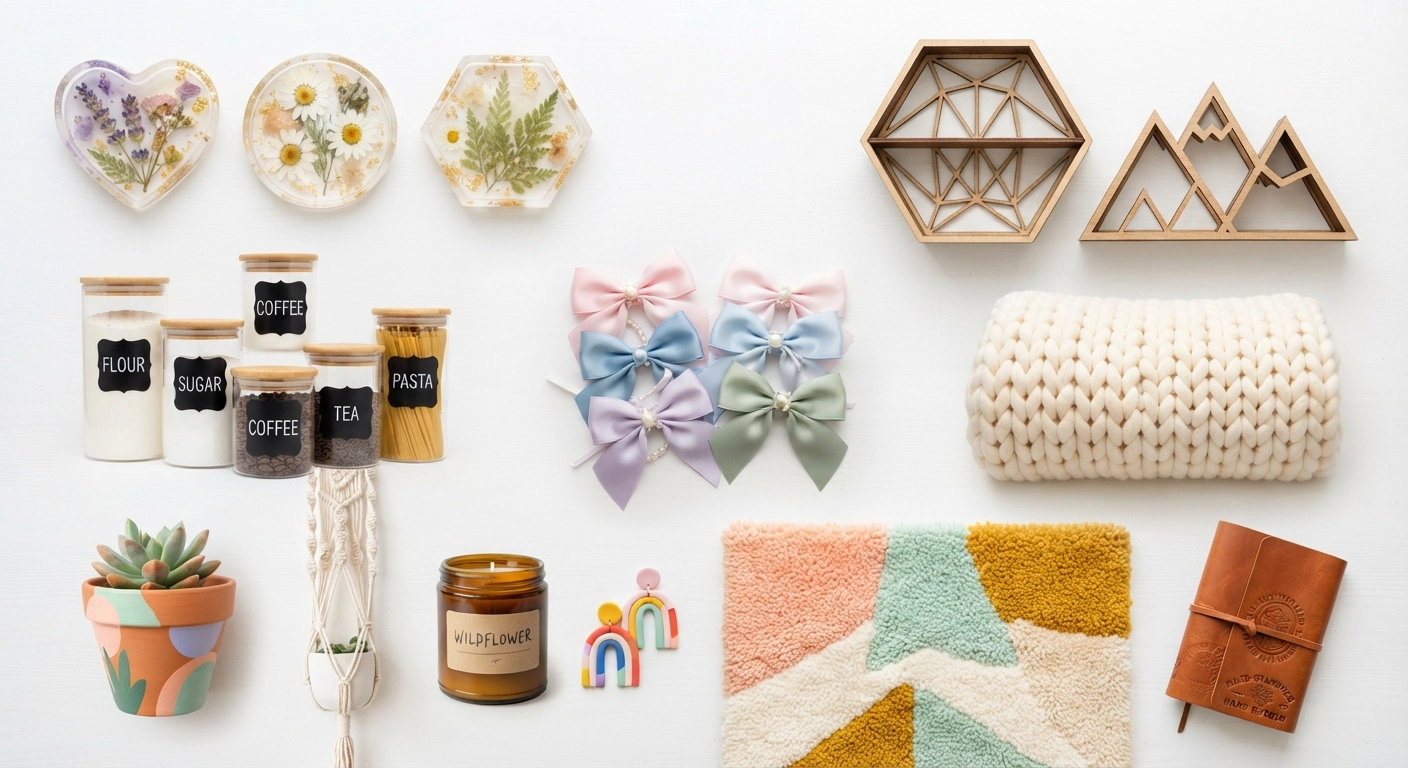
<!– image_prompt: A vibrant flat-lay photograph of the top 10 most profitable craft niches for 2026, including resin keepsake dishes with dried flowers, laser-cut wooden geometric shelves, tufted rug samples in pastel colors, chunky knit blankets, Cricut vinyl labels on pantry jars, and coquette satin hair bows. Professional lighting, clean white background, lifestyle aesthetic.
–>
<!– image_prompt: A split-screen comparison showing the raw material costs on one side (plywood sheets, resin bottles, yarn skeins, vinyl rolls) with small dollar amounts, and the finished high-end products on the other side (geometric shelves, preserved wedding bouquet resin tray, tufted abstract rug, personalized pantry organization kit) with premium price tags. Educational infographic style.
–>
<!– image_prompt: A cozy home workshop scene with a craft business owner smiling while packaging orders. Shipping boxes, a laptop showing Etsy dashboard with sales notifications, and various craft supplies organized on pegboards. Natural window lighting, warm and aspirational atmosphere highlighting the profitable craft niches lifestyle.
–>