Etsy vs Shopify: Where to Sell Your Easy DIY Crafts in 2026? A Brutally Honest Comparison

- Etsy vs Shopify: Where to Sell Your Easy DIY Crafts in 2026? A Brutally Honest Comparison
- 📋 Key Takeaways
- Table of Contents
- The "Big" Difference: Marketplace vs. Your Own Brand
- The "Gifted" Trust of the Marketplace
- The "Long-Game" Value of Brand Equity
- The 2026 Fees Shootout: Where Your Margin Actually Goes
- The Traffic Secret: Why "0 Views" Happen on Shopify
- The Search Algorithm: Etsy SEO Demystified
- The Google Dependency: Shopify SEO Carries More Weight
- The Hybrid Profit Funnel: Stop Selling, Start Systemizing
- Step 1: The Packet Insert (The Trojan Horse)
- Step 2: The Digital Bridge Product
- Physical vs. Digital Crafts: A Critical Platform Split
- For Physical Inventory: Etsy Wins the Impulse War
- For Digital Downloads: Shopify Needs Apps, Etsy Gets Complaints
- The Hidden "Time" Tax: Setup Difficulty Face-Off
- Frequently Asked Questions (FAQ)
- Is Etsy or Shopify better for absolute beginners in 2026?
- Can I use Etsy and Shopify at the same time?
- Which platform has fewer fees when selling crafts?
- Do I own my customer data on Etsy?
- How does the "Buy with Prime" feature affect selling crafts on Shopify in 2026?
- Is Etsy saturated, or can I still sell my DIY crafts?
- What craft niches are exploding for online sales now?
- The Final Verdict: A 3-Month Action Plan for 2026
- 🔗 İlgili İçerikler
September last year, I had a meltdown in my garage. The boxes of unsold handmade soy candles, the stacks of personalized coasters, and the “unique” resin keychains were literally gathering dust. I had opened my Etsy shop a year earlier with a dream, but the constant fees and lack of traffic made me wonder if building my own site was the better play. I knew the problem wasn’t my craft; it wasn’t even the price. The bottleneck was the platform itself. If you are drowning in analysis paralysis asking yourself the question “etsy vs shopify for selling crafts,” you are not just picking a website builder. You are choosing a business model. You’re deciding whether to pay for instant visibility or invest in your own brand. You are picking between being a renter in a busy mall or owning your shop on a quiet but private street.
After dragging my inventory across both platforms for two years and burning about $3,000 in testing ads (and learning some very expensive lessons), I finally cracked the code. By the end of 2025, my Shopify store was handling repeat customers on autopilot, but weirdly my Etsy store still made me the most “impulse buy” cash. It’s not about which one is “better” in a vacuum. It’s about which one is smarter for your specific stage of business. In this Etsy vs Shopify for selling crafts deep dive, I’m going to show you the real numbers—the hidden transaction fees, the algorithm secrets, the time investments, and the exact strategy that lets you master both in 2026.
📋 Key Takeaways
- Etsy is a traffic machine—perfect for impulse buyers and immediate sales, but you don’t own the customer relationship.
- Shopify builds your brand equity—crucial for scaling and repeat buyers, but you must bring your own traffic.
- The “Winner” isn’t static; the smartest crafters in 2026 are using a hybrid funnel strategy (Etsy for acquisition, Shopify for retention).
- Transaction fees on Etsy can silently drain 15-20% of your profit if you don’t price correctly.
- Don’t overlook the “Time-Cost” factor; Etsy gets you selling in hours, Shopify requires a solid weekend for a professional DIY craft store setup.
Table of Contents
- The “Big” Difference: Marketplace vs. Your Brand
- The 2026 Fees Shootout: Where Your Margin Actually Goes
- The Traffic Secret: Why “0 Views” Happen on Shopify
- The Hybrid Profit Funnel: Stop Selling, Start Systemizing
- Physical vs. Digital Crafts: A Critical Platform Split
- The Hidden “Time” Tax: Setup Difficulty Face-Off
- Frequently Asked Questions (FAQ)
- The Final Verdict: A 3-Month Action Plan for 2026
The “Big” Difference: Marketplace vs. Your Own Brand
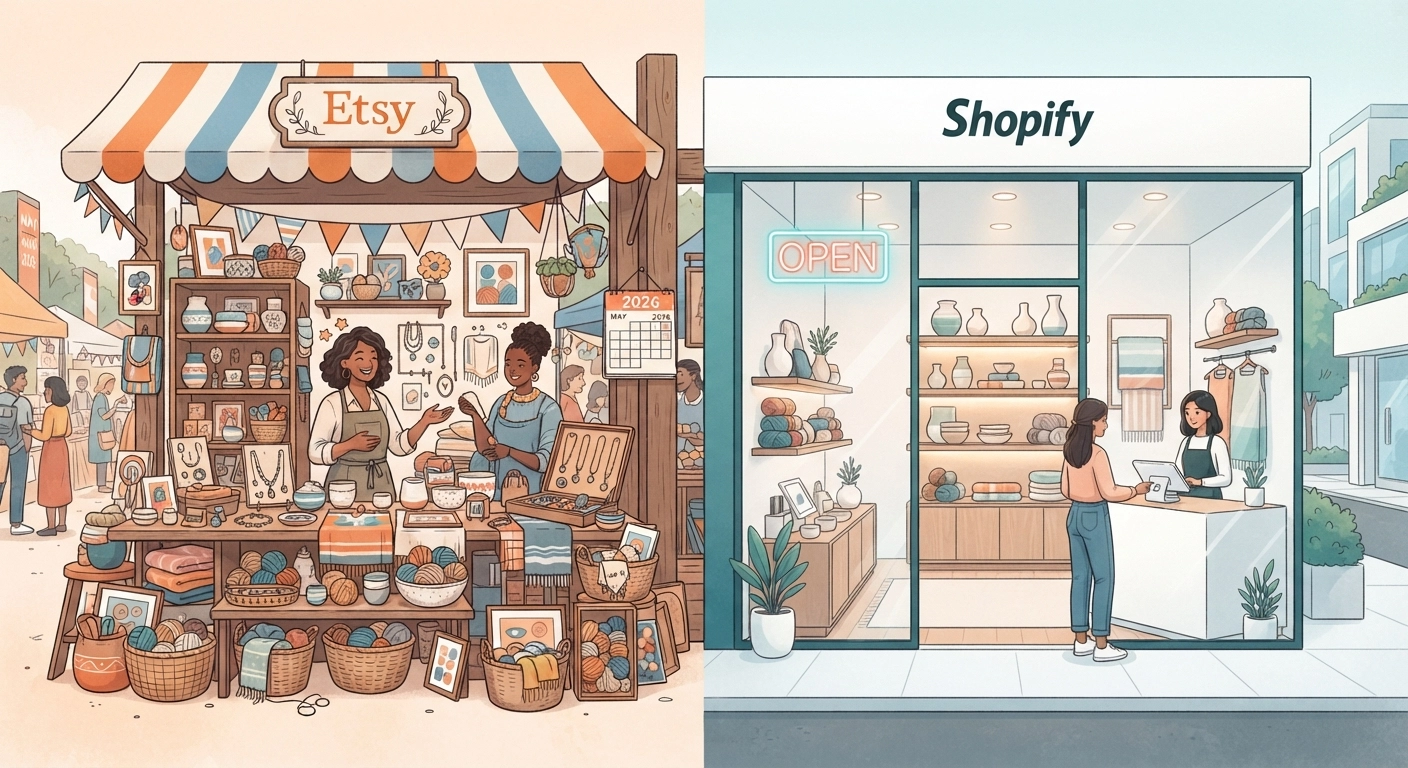
When you compare Etsy vs Shopify for selling crafts, you aren’t comparing two e-commerce tools; you are comparing a bustling flea market to a blank plot of land. On Etsy, the customers are already there, 96 million of them (Source: Statista, 2024 Data). They are actively typing “handmade birthday gift for mom” into the search bar. Shopify, on the other hand, is an empty canvas. It’s powerful, but the silence can be deafening if you don’t understand the psychology of the two players.
The “Gifted” Trust of the Marketplace
Etsy comes with built-in trust. A customer feels safe entering their credit card because they trust Etsy’s case system. As a seller, this lowers the barrier to purchase. However, there is a dark side: anonymity. A buyer purchases a craft, but they remember the platform, not your shop name. I can’t count how many times a repeat customer said, “I bought candles from Etsy!” not “I bought them from [My Shop Name].”
The “Long-Game” Value of Brand Equity
Shopify is about asset building. Every visitor, every email collected, and every pixel loaded adds value to your company, not a marketplace. If you plan to sell your DIY business one day, a Shopify store with 5,000 email subscribers and a clean profit history has a valuation. An Etsy store with the same numbers is virtually unsellable (or dependent entirely on the platform’s mercy). For anyone serious about turning a side hustle into a legacy, Shopify is the technical infrastructure you need.
The 2026 Fees Shootout: Where Your Margin Actually Goes
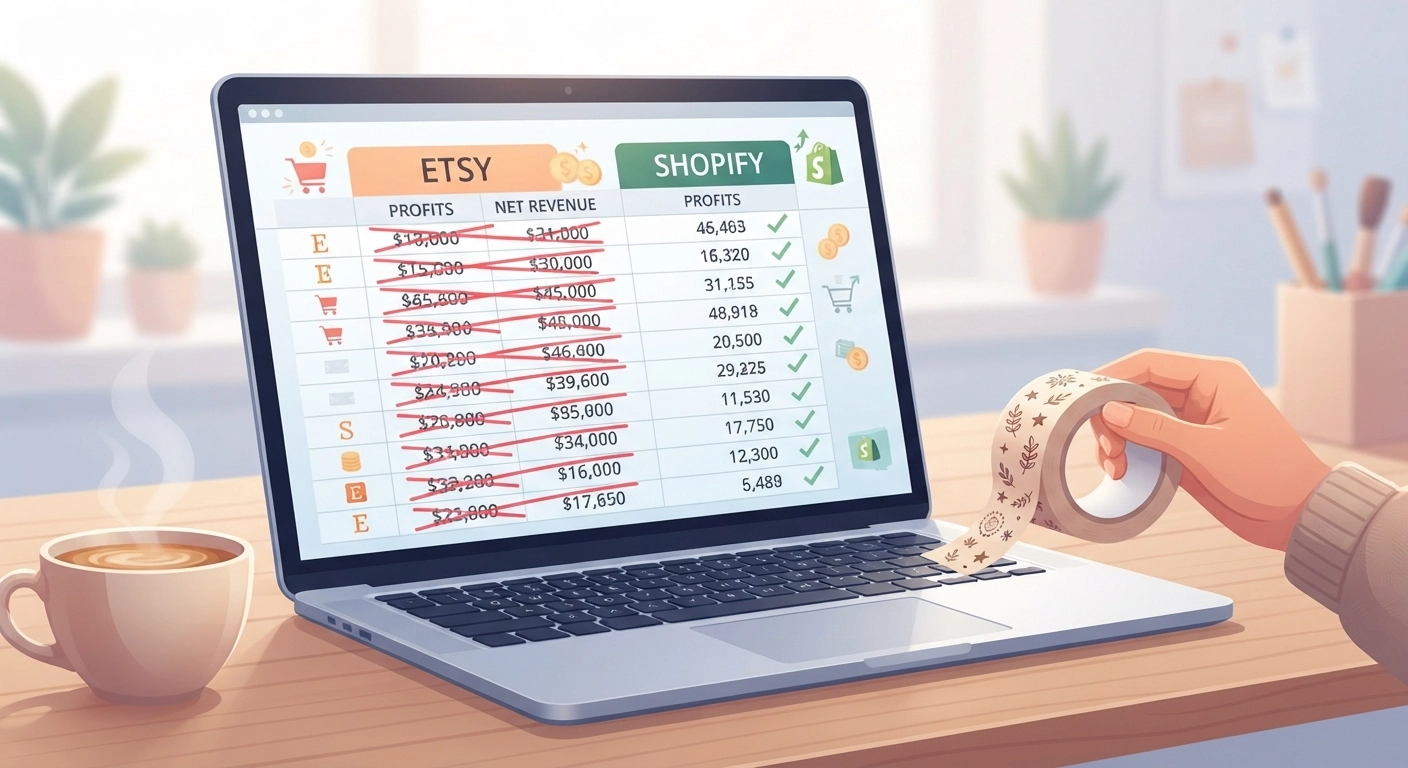
“Etsy fees are killing me” is the battle cry of many crafters. Let’s break down the etsy vs shopify for selling crafts cost analysis with transparent numbers. Most comparisons stop at the monthly subscription, but the real killer lurks in the transaction details. In 2026, understanding the difference between a “taker rate” and a “flat rate” is the difference between a 10% and a 50% profit margin.
| Fee Type | Etsy (Standard) | Shopify (Basic Plan) |
|---|---|---|
| Monthly Access | $0 (Free to open) | $39/mo (or ~$29/yr if paid annually) |
| Listing Fee | $0.20 per item (lasts 4 months) | $0 |
| Transaction Fee | 6.5% of sale price (incl. shipping) | 2.9% + $0.30 (Standard CC rate) |
| “Hidden” Ad Fee | 15% offsite ads fee (if sale came from ad) | $0 (You control ad spend) |
| Effective Rate on a $100 Sale | ~$12.70 (risks high) | ~$3.20 (stable) |
The Etsy offsite ads program is where margins go to die. If you make over $10,000 in a year, you’re forced into this program. You can’t opt out, and they take a 15% cut of the entire order if a customer clicked a Google ad for your product within the last 30 days. Shopify, by contrast, gives you a flat, predictable gate. If you sell high-ticket items like DIY outdoor dining tables, the Etsy fee becomes painfully high; on Shopify, you keep the profit.
The Traffic Secret: Why “0 Views” Happen on Shopify
Let me tell you a story about my “zero dollar months.” When I first launched my Shopify vinyl decal shop, I naively thought “If you build it, they will come.” I spent three weeks perfecting the css, creating beautiful product pages for my custom vinyl decals, and hit publish. Silence. In that first month, Shopify registered 4 visitors, and I’m pretty sure 2 were my mom and one was a bot. This is the brutal reality of etsy vs shopify for selling crafts. Etsy pours visitors onto your page like a faucet; Shopify hands you a bucket and asks you to walk to the river.
The Search Algorithm: Etsy SEO Demystified
On Etsy, your rank depends purely on “Query Matching.” The platform’s search algorithm in 2026 heavily favors listing quality scores. If you can master keyword stuffing in your title (like “Personalized Teacher Gift, Appreciation Present, Spa Kit”), you get found. It’s a skill, and it works fast. You can list an item Monday morning and have a sale by Tuesday night, especially if you are in a trending niche like easy Cricut projects to sell.
The Google Dependency: Shopify SEO Carries More Weight
Shopify forces you to become a marketer, which isn’t a flaw—it’s an investment. Instead of competing in Etsy’s cluttered feed, you are competing on Google. You need to target long-tail keywords like “buy hand-painted terracotta pots for succulents” on your blog. It takes 3-6 months for a new Shopify domain to climb Google rankings, but once you do, an organic sale on a site like Shopify is 100% profit; you owe no transaction fee to Etsy. The traffic isn’t “borrowed”; it’s a sustainable asset. This is why we insist that learning basic SEO is non-negotiable for Shopify success.
🤔 Engagement Hook: Imagine the Etsy algorithm changes tomorrow (it happens every few months). If your traffic drops 80% overnight, can you still pay rent? If the answer scares you, you need a backup plan (Shopify). If you don’t mind riding the algorithmic waves, Etsy is still the fastest cash in 2026.
The Hybrid Profit Funnel: Stop Selling, Start Systemizing
I don’t want you to choose between etsy vs shopify for selling crafts. I want you to weaponize them against each other. Here is the exact “Hybrid Funneling” strategy that the top 1% of makers use. You use Etsy as a “paid lead gen” tool—yes, even with the fees—and Shopify as the profit center.
Step 1: The Packet Insert (The Trojan Horse)
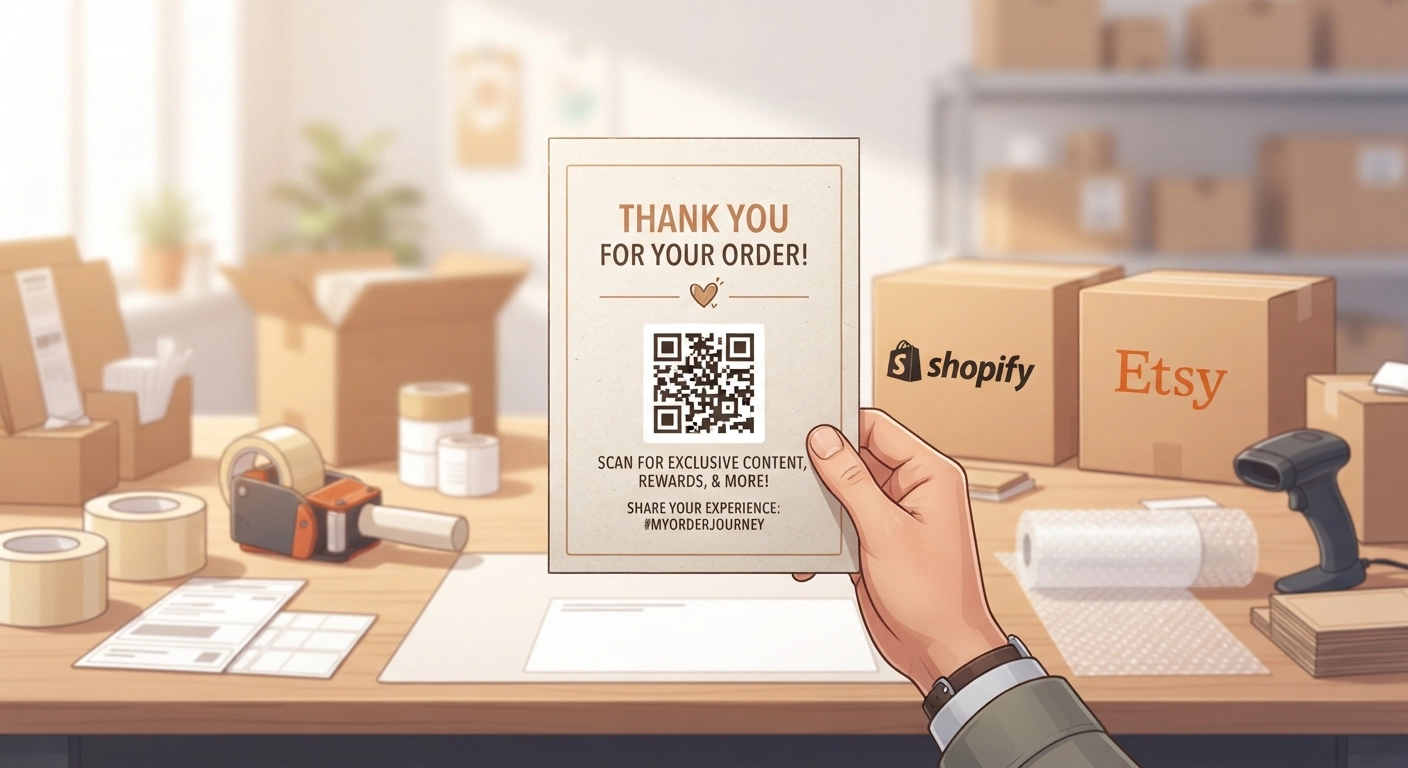
Every time you ship an Etsy order, do not stick a business card saying “Visit my Etsy shop!” That is business suicide. Instead, include a beautifully designed thank-you card, maybe one of those custom cuts you can make on a Cricut, that says: “Get 20% off your next order + Free Shipping when you shop directly on our site: [YourShopifyURL].” The math is simple. A repeat customer bought on Etsy costs you ~12%. The same customer on Shopify costs you ~3%. You just bumped your margin by 9% on pure loyalty.
Step 2: The Digital Bridge Product
Selling physical items on Etsy is heavy. Use it to sell a low-priced digital product that collects emails. For example, sell a “Printable Pantry Guide” or a “Pattern Blueprint” related to your craft. A $5 digital download has a 97% margin. In the PDF, hyperlink a “Video Tutorial” that lives on your Shopify store or Mailchimp landing page. Now, Etsy found you a buyer, you got their email, and they are in your Shopify funnel forever.
Physical vs. Digital Crafts: A Critical Platform Split
This is the most overlooked variable in the whole debate. What you make dictates what you should use. If you’re printing t-shirts, that’s inventory. If you’re selling PDF art downloads, that’s a server fee. Let’s see how etsy vs shopify for selling crafts plays out for these two totally different business models.
For Physical Inventory: Etsy Wins the Impulse War
Handmade physical items like custom t-shirts or soy candles rely on impulse. On Etsy, the “gift mode” feature pushes physical products straight to buyers who want something tactile. However, Shopify recently launched its own “Shop” app with tracking, making physical fulfillment smoother than ever. If your craft is large or requires specific shipping dimensions (like DIY raised garden wood structures), Shopify’s shipping profiles are far superior to Etsy’s rigid calculator.
For Digital Downloads: Shopify Needs Apps, Etsy Gets Complaints
Etsy’s file size limits and occasional download glitches drive customers crazy. Shopify, with the free “Digital Downloads” app, gives you total control. If you are in the lucrative niche of selling printables and digital planners, Etsy is an easier start because people specifically search for “digital download” there. But as you scale, the “mega file” issue makes Shopify a necessity. Many successful digital sellers use both: Etsy for discovery, Shopify for bundling and higher-priced “master classes.”
The Hidden “Time” Tax: Setup Difficulty Face-Off
I often ask my coaching clients: “Do you have 2 hours or 2 days?” Because that’s the real setup time difference. Etsy is “plug-and-play.” You upload a photo, set a price, and your store is theoretically open. Shopify is more like assembling a piece of IKEA furniture. It’s sturdy and brilliant, but you might need a screwdriver and some coffee.
- Etsy Setup Time (2026): 30-45 minutes. The hardest part is the banner and “About” section. The system bottlenecks you into their SEO, which forces you to get discovered fast.
- Shopify Setup Time (2026): 6-8 hours for a professional look. You need to select a premium theme, customize the color palette, set up legal pages (Refund/Privacy), configure tax collection for your state/region, and install a payment gateway. It’s a heavy lift, but it’s a one-time tax.
If you are just testing a hobby to see if anyone likes your style, starting on Etsy first is the pragmatic, low-risk path. But don’t wait too long to build a home base elsewhere.
Frequently Asked Questions (FAQ)
Is Etsy or Shopify better for absolute beginners in 2026?
Etsy is objectively better for absolute beginners with zero marketing budget. Because it functions as a search engine, you can write a good title and make a sale within the first 48 hours without running a single ad. Shopify requires you to immediately think about driving traffic, which can be demoralizing if you just want to test if your handmade crafts are profitable.
Can I use Etsy and Shopify at the same time?
Yes, and you should. The most resilient business model in 2026 is the “dual storefront.” However, never sync inventory automatically unless you have a robust system; overselling on both platforms simultaneously is a fast track to negative reviews. Use Etsy for new customer discovery and Shopify for existing customer retention and subscription boxes.
Which platform has fewer fees when selling crafts?
For high-volume or high-ticket items, Shopify has significantly lower effective processing fees (usually under 3%). Etsy’s fees can easily eclipse 15% once offsite ads and shipping transaction percentages kick in. However, Shopify has a fixed monthly subscription; if you make zero sales, you still pay. Etsy costs $0 if you make $0.
Do I own my customer data on Etsy?
No. This is the fatal flaw of Etsy. You cannot export customer email lists to market to them via newsletter unless you trick the system with crafty inserts (as described above). On Shopify, every checkout is an email capture for your list. If you value email marketing, Shopify is the only choice that respects your data ownership.
How does the “Buy with Prime” feature affect selling crafts on Shopify in 2026?
Shopify currently allows a “Buy with Prime” app integration in some regions. This bridges the gap beautifully. It allows Amazon Prime users to check out using their Amazon wallet on your Shopify store. For crafts, this adds a layer of trust similar to Etsy’s case system, potentially boosting Shopify conversion rates by 15-20%.
Is Etsy saturated, or can I still sell my DIY crafts?
Etsy is saturated with generic, low-effort print-on-demand. It is not saturated with unique, handcrafted niche products. To win in 2026, avoid searching for “popular trends” and instead search for under-served communities. Think “custom DnD dice bags” or “vintage botanical shower curtains”—items that require actual craftsmanship, not just a mockup. The barrier to quality is your only protection.
What craft niches are exploding for online sales now?
While the basics always sell, 2026 has a massive swing toward “kits.” People don’t want finished products; they want to buy the materials to make it themselves on a Friday night. Selling “Craft Kits” (a box of yarn, pattern, and a QR code to a private tutorial) on Shopify is crushing it. You can find out which specific items are trending by checking out our guide on the most profitable craft niches for 2026.
The Final Verdict: A 3-Month Action Plan for 2026
We have beaten the data to death. Let’s map out your action plan so you don’t freeze up. If you are holding a product in your hand right now and need cash flow to buy more materials for your garage workshop, go list on Etsy. Do it tonight. There is no shame in riding the marketplace wave to fund your dreams. But if you’ve already made a few hundred sales and feel the pain of losing 12% of your income to a platform that restricts your access to your own buyers, it’s time to build your fortress.
By leveraging Shopify for your brand identity, you aren’t just selling crafts—you are building a scalable asset. Don’t just pick a side. Be a craft business owner smart enough to play both. Use Etsy’s 96 million shoppers as your marketing budget, and Shopify’s checkout as your bank vault. That’s the real secret to winning the etsy vs shopify for selling crafts war in 2026.
Ready to stop worrying about platform fees and start building a craft business that actually pays you?
Explore our full library of DIY business building guides and learn how to automate your product creation so you have more time to sell.